top of page
Centre for

East Asian Studies

"Colección Japón" (Japan Collection) was created with the aim of bringing together works on Japanese studies with the scientific rigor necessary for the academic community, while also offering a collection of works that contribute to a broader understanding of Japanese culture. This provides direct access to fundamental works of Japanese culture that have not been disseminated in the Spanish-speaking world, as well as rigorous research on lesser-known aspects of Japanese culture.
In that same spirit, starting in March 2025, the first titles in the collection will be progressively offered in open access , facilitating free and universal access to knowledge.
This collection received a Special Mention in 2022 at the 25th National University Publishing Awards of the Union of Spanish University Publishers (UNE): "Special Mention for the Japan Collection (Autonomous University of Madrid), thanks to bringing the Japanese language and literature closer to and disseminating it to Hispanic readers."
"Colección Japón" (Japan Collection) was created with the aim of bringing together works on Japanese studies with the scientific rigor necessary for the academic community, while also offering a collection of works that contribute to a broader understanding of Japanese culture. This provides direct access to fundamental works of Japanese culture that have not been disseminated in the Spanish-speaking world, as well as rigorous research on lesser-known aspects of Japanese culture.
In that same spirit, starting in March 2025, the first titles in the collection will be progressively offered in open access , facilitating free and universal access to knowledge.
This collection received a Special Mention in 2022 at the 25th National University Publishing Awards of the Union of Spanish University Publishers (UNE): "Special Mention for the Japan Collection (Autonomous University of Madrid), thanks to bringing the Japanese language and literature closer to and disseminating it to Hispanic readers."

"Colección Japón" (Japan Collection) was created with the aim of bringing together works on Japanese studies with the scientific rigor necessary for the academic community, while also offering a collection of works that contribute to a broader understanding of Japanese culture. This provides direct access to fundamental works of Japanese culture that have not been disseminated in the Spanish-speaking world, as well as rigorous research on lesser-known aspects of Japanese culture.
In that same spirit, starting in March 2025, the first titles in the collection will be progressively offered in open access , facilitating free and universal access to knowledge.
This collection received a Special Mention in 2022 at the 25th National University Publishing Awards of the Union of Spanish University Publishers (UNE): "Special Mention for the Japan Collection (Autonomous University of Madrid), thanks to bringing the Japanese language and literature closer to and disseminating it to Hispanic readers."
.jpg)
MODE AND MODALITY
CONTRASTIVE STUDY
BETWEEN JAPANESE AND SPANISH
NORITAKA FUKUSHIMA
Japanese and Spanish belong to distant language families and appear to have profoundly different structures, in some cases nonexistent in either language, as is the case with the subjunctive mood, a mood absent in Japanese. However, there are syntactic, lexical, and pragmatic structures in Japanese that allow for the expression of this mood despite its apparent absence. This book offers a contrastive linguistic study of the phenomenon of mood and modality. To do so, it draws on data from different corpora, surveys that analyze degrees and judgments of grammaticality, and tests of sentence transposition and addition. Due to the objectivity and uniqueness of the treatment of this data, this work is highly useful for those interested in the question of mood and modality from a contrastive perspective.
This work also seeks to take a further step in the study of the functional opposition between the indicative and subjunctive moods of contemporary Spanish, both European and American, always from the perspective of contrast with a typologically different language. The hypothesis proposed by the author offers explanations not only of the basic uses of modal selection but also of numerous exceptional uses, such as the presence of the subjunctive in real contexts and that of the indicative in virtual contexts. Furthermore, this hypothesis allows us to account for differences in modal selection.

TALES FROM ANCIENT INDIA IN THE KONJAKU MONOGATARI-SHU
Efraín Villamor Herrero
Reading the most extensive collection of short stories from mediaval Japan, a surprising section of stories is discovered
about ancient India. These tales transport us to a
fascinating world and teach us how the transmission of the
mythology and beliefs of ancient India at the service of
Japanese Buddhist catechism.
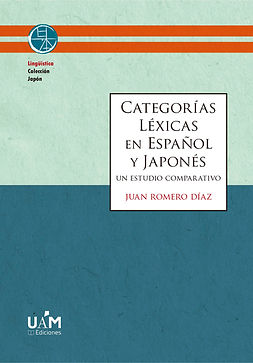
LEXICAL CATEGORIES IN SPANISH AND JAPANESE: A COMPARATIVE STUDY
Juan Romero Díaz
The lexical categories of Spanish and Japanese differ in both their number and their syntactic-semantic properties, which causes numerous difficulties for speakers of both languages. This paper aims to conduct a comparative study of the lexical categories of these languages to systematize the lack of intercategorical correspondence and thus contribute to improving their teaching. To establish the underlying differences, a chapter is dedicated to each lexical category (noun, adjectival noun, adjective, verb, and verbal noun), paying attention to their general characteristics and presenting various proposals for their classification. The lexical and syntactic features of some lexical items are also analyzed in detail to determine the cause of errors in the learning of each language as an L2/FL within the theoretical framework of the Generative Lexicon. This research can be considered pioneering in the comparative analysis of lexical categories in Spanish and Japanese, since there are still few studies that apply the theoretical assumptions of the Generative Lexicon to the field of second language acquisition.

JAPAN IN SPANISH
THE DISSEMINATION OF JAPANESE CULTURE THROUGH BOOKS (1868-1945)
Elena Barlés Báguena & Muriel Gómez Pradas (Editors)
The research addressed in this collective work reveals how in Spain, during the period between 1868 and 1945, there were real opportunities to achieve a significant level of knowledge about Japan (much more than that defined by traditional historiography) through the books disseminated throughout Spain in Spanish. The work demonstrates the richness of this body of texts, the wide variety of topics they covered, the different nature and origins of the authors who wrote them, the diverse points of view from which they were crafted, and the different images of Japan they conveyed; books that were undoubtedly the product of the changing social and political situations in Spain and Japan, as well as the fluctuating relations the two countries established over this period. This cross-cutting proposal analyzes in detail a selection of some of the most relevant or unique texts.

THE ESSENCE OF NOVEL BY TSUBOUCHI SHŌYŌ
Kayoko Takagi Takanashi; José Pazo Espinosa; Tsubouchi Shōyō
The Essence of The Novel (Shōsetsu shinzui) is the first theoretical treatise on this genre in Japan and revolutionized the literary scene at the beginning of the Meiji era. It is an essential work for understanding the complicated historical development of creative literature, which in just a few years would produce important results for authors of different tendencies. If the young writers of the time applauded the new literary theory, they also understood that the ancestral style in which stories were told was no longer useful. The work addresses the problems of Japanese literature that caused so much cultural and sociopolitical debate and shows the new parameters of the written style of the new era.
This study offers a complete translation of the text into Spanish for the first time, along with historical context and insights into the life and personality of the author, Tsubouchi Shōyō. It also includes a critical analysis of the work and the early novels that put his theories into practice.
Review
Review 2

PATHS TO THE INTERIOR AND SORA'S DIARY
Luis Manuel López Gómez; Matsuo Bashō, Kawai Sora
"The Narrow Road to the Interior" is the poetic diary of the poet who shaped haiku as we know it today: Matsuo Bashō. Throughout pages marked by the dialogue of prose and verse, northern Japan is embodied in words, just as its rivers and mountains are born from the birth of water and stone. This work presents a new translation of this Japanese classic, which has been warmly received in our language, supported by a critical analysis for the benefit of readers. It also provides the first complete translation into a Western language of the travel diary of Bashō's disciple, Sora, which shows the true journey and the events they experienced with greater rigor and truthfulness. Together, the two diaries demonstrate the beauty of truth in the natural combination of history and poetry.
Review

SHIMABARAKI, A CHRONICLE OF THE SHIMABARA REBELLION
Gonzalo San Emeterio Cabañes
This work presents for the first time in Spanish one of the oldest chronicles narrating these events. Written in 1640, two years after the violent repression, the Shimabaraki (島原記), or Shimabara Chronicle, offers not only a detailed description of the events but also some of the perceptions toward Christianity and the outside world that would characterize Japanese society until the reopening of its borders to Western powers in the mid-nineteenth century.
Review

EXPLORATIONS OF SPANISH-JAPANESE CONTRASTIVE LINGUISTICS
Toshihiro Takagaki (Editor)
The teaching of Spanish in Japan has more than a century of history. This book argues that two languages from such distant families can be characterized by comparing and contrasting, in an "equidistant" manner, the comparable structures and functions of both languages.
About the Author: Toshihiro Takagaki is Professor Emeritus at the Tokyo University of Foreign Studies, where he received his PhD in Linguistics. His research focuses on Spanish grammar, lexical and grammatical variation in Spanish, and contrastive linguistics between Spanish and Japanese.

WORKS ON SPIRITUALISM
Kiyozawa Manshi; Bernat Martí Oroval
In this anthology, we present for the first time in Spanish some of the most representative writings of the late thought of Kiyozawa Manshi (1863-1903). A monk of the True Pure Land school of Buddhism, Kiyozawa was one of the first Japanese to specialize in philosophy, a discipline he studied at the then-recently established University of Tokyo. His essays, straddling the philosophical thought then newly introduced from the West and Buddhist tradition, make him one of the most original thinkers of the Meiji period (1868-1912).

ANALYSIS ON THE USE OF JAPANESE PARTICLES WA AND GA BASED ON THE CORPUS OF SPANISH STUDENTS
Emi Takamori
Despite the increase in Japanese language learners in Spain over the last decade, there is no data showing how Spanish students conduct communicative interactions in Japanese. Analyzing not only errors but also correct usage with the corpus directly reveals the factors that hinder learning. Among the various elements we can investigate with the corpus, this study aims to focus on the uses of the particles wa and ga, elements that are difficult to master due to the variety of functions each particle has.
Review
bottom of page